How I read 52 books in a year
My book tracking app alerted me that I read 52 books over the last twelve months. So, franticly crunching numbers yes, indeed, that averages to one book per week!
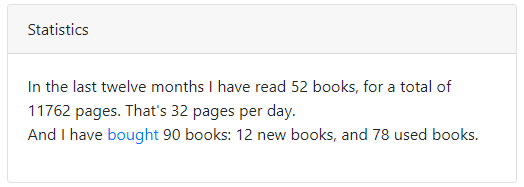 This brings the book average to 226 pages per book.
I follow a couple of blogs of people that read waymore than I do. Like these guys, respectively read 116, 105, 74 and 58 books in 2019. I don't know how they managed to do so, but 52 is definitely a personal best for me and this blogpost is about how I did this.
When I say that I have read a book, I mean: I read it cover to cover. No skimming or skipping, or glossing through. That's not reading. And no audio books. Nothing against that, but my point is to read a book as the author intended it (of course, this is different when you study a subject and need to pick and choose parts).
Full disclosure, I am currently experimenting reading Moby Dick with the book in hand and the audio book playing along. It's fun, and a good way to get your teeth into such a classic. But I still need my eyes to follow the words and I don't think listening to an audiobook while doing other things is the same experience. A book is not a podcast.
Getting serious
I've always liked reading but if I had to state a regret it would still be that I wish I had read more. There is always a certain anxiety when I enter a library or bookstore. The average human, or even a frantic reader, will never read more than a few thousand books in their lifetime. So I can never read just what my local library has in stock: even if it takes a lifetime. There are just too.many.books. With this in mind, a minute watching TV is a minute wasted reading.
I realised I find few activities more rewarding than reading. With this realisation in mind I consciously decided that I would take reading more seriously. And of course I still watch a little bit of TV and movies, but just a bit more consciously.
Here are some principles I developed around reading to keep me on track.
Principle 1: Track broadly
For me, this is key. So much so, that last year I wrote my own book tracking app, to exactly fit my needs. In my app I cannot only track what I have read, or am currently reading, but also what I wantto read.
I used to use a spreadsheet, whatever works for you, but I was often getting lost in what I was reading (see Principle 2). So having this app definitely helps.
Principle 2: Read widely
This may be the most important principle on multiple levels. It not only means that I want to read many different books or genres but also that I like to read them simultaneously.
Of course I have favorite genres or subjects, but I try to be open-minded about every book (I wouldn't snuff Danielle Steele). You never know what you might learn about yourself.
Levels
And before I meticulously kept track, thisis usually where I got lost. Not every book demands the same energy or attention level and you should be able to switch it up without regret.
Which I do. So at a certain point last year I was reading 11 different books at once: diaries, biographies, novels, management books, historical books. You name it. Because my app allows me to directly see what I startedit's easy to keep track of this and -- most importantly -- switch it up when I am not feelinga certain book. Instead of dreading picking up a certain book for months or a half read book getting lost on my bookshelf I just move on to a different book, and know I will eventually get to that book. My app tracks it. And I always do! Some books I haven't touched in months but I pick em up again after some time when I feel like it, and more often than not it's usually a better experience. I have now had this experience more than once. And it was quite the revelation. The lesson is: different moods ask for different books.
So far I only actively stopped reading two books, with no intention of reading any further ever (this is fine!). So this is rare. Most books I start, I have already done a little bit of research, to know enough that I want to read them.
Another benefit when you switch a lot between books is that I noticed it helps to retain what the books are about. It's a different experience when you read a book over two months as opposed to two days. Because you have to actively remind yourself of what the book was about again.
Principle 3: Buy loosely
The app allows me to add books to my wish list, and as you can see in the screenshot I bought 90 books last year. Mostly from thrift stores, they are absolute goldmines. And yes, I don't read e-books. I need to feel paper.
The 'Books I want' list from my app is a guideline for thrift store visits, but mostly I just look all over the place. And I used to be a bit hesitant to buy a book, as it would indicate a future commitment to myself to read it. But since reading Nassim Nicholas Taleb's Black Swan and his thoughts on famous writer Umberto Eco's personal library (here and here), I have been able to shake this habit a bit. So if a book looks interesting: buy it!
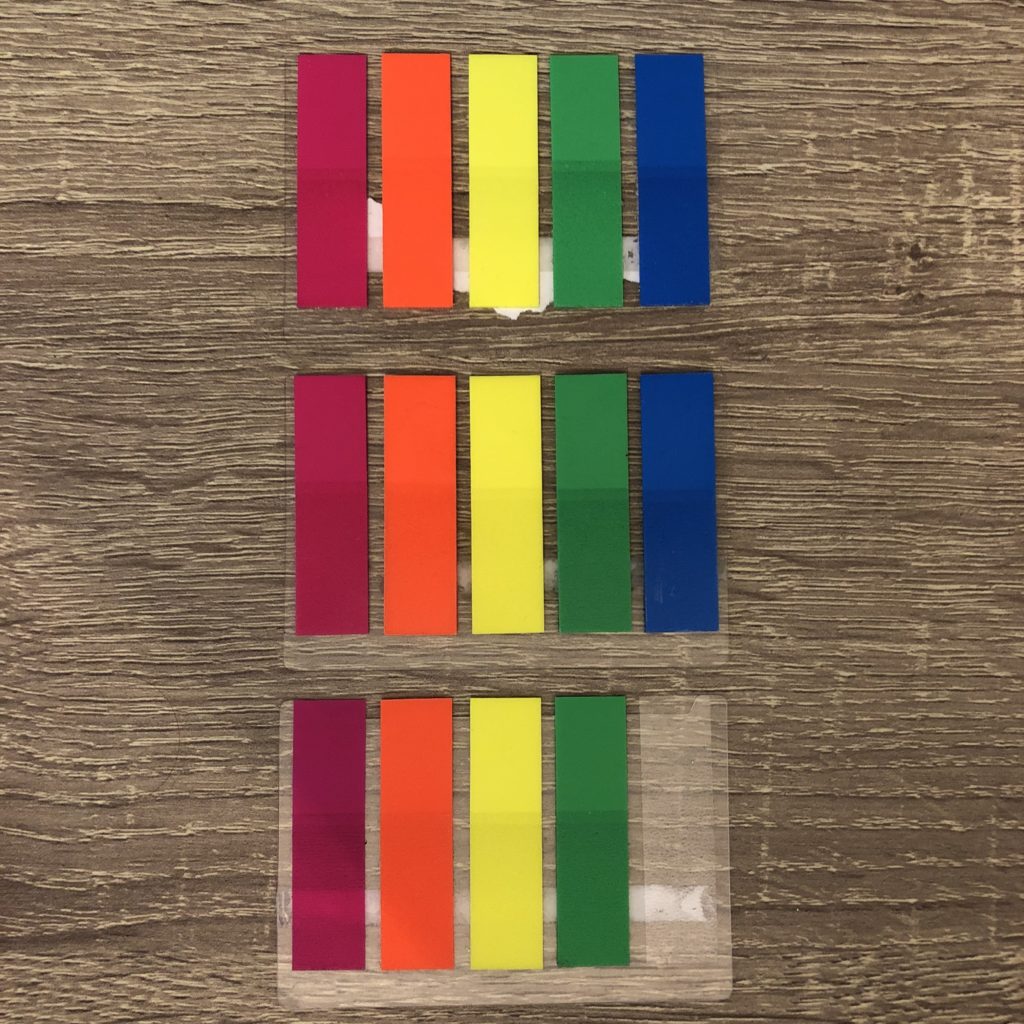 Bookmark stickies.
Tips
So those are the three main principles. Here are some other tips that help to keep your reading on track.
- I dislike using a highlighter. It ruins books. Even if it's just paper that got for 50 cents a thrift store.
- I have used the classic highlighters and last year I moved to a pencil highlighter, a little bit less permanent but still not great. So since a couple of months I use TRANSPARENT bookmark stickies.
- They are not permanent.
- I can still read what I highlighted.
- I can remove them without tearing the paper.
- It doesn't matter what type of book it is, I read every book with a stack of sticky bookmarks and annotate what I like or want to remember. (This would definitely be my number one reason to move to eBooks at some point..).
- To retain things, I usually read the sticky parts again after finishing or when picking up a book if it has been a while.
- Read everyday. Even it's just a couple of minutes. Don't break the chain. Create a habit.
- Put your phone on mute. I do most of my reading between 8 and 10 pm. If you text or call me between those hours, I probably won't see or hear it.
- Write! After all, what good is reading if you don't write? I tend to blog about every book I read (few exceptions: i.e. when it's a really small book). This helps with retention and thinking about what you liked or want to remember. And also you create your own little archive. I often look up my own posts, to see what I was thinking.
So there you have it! Now, let's see what's on TV.